

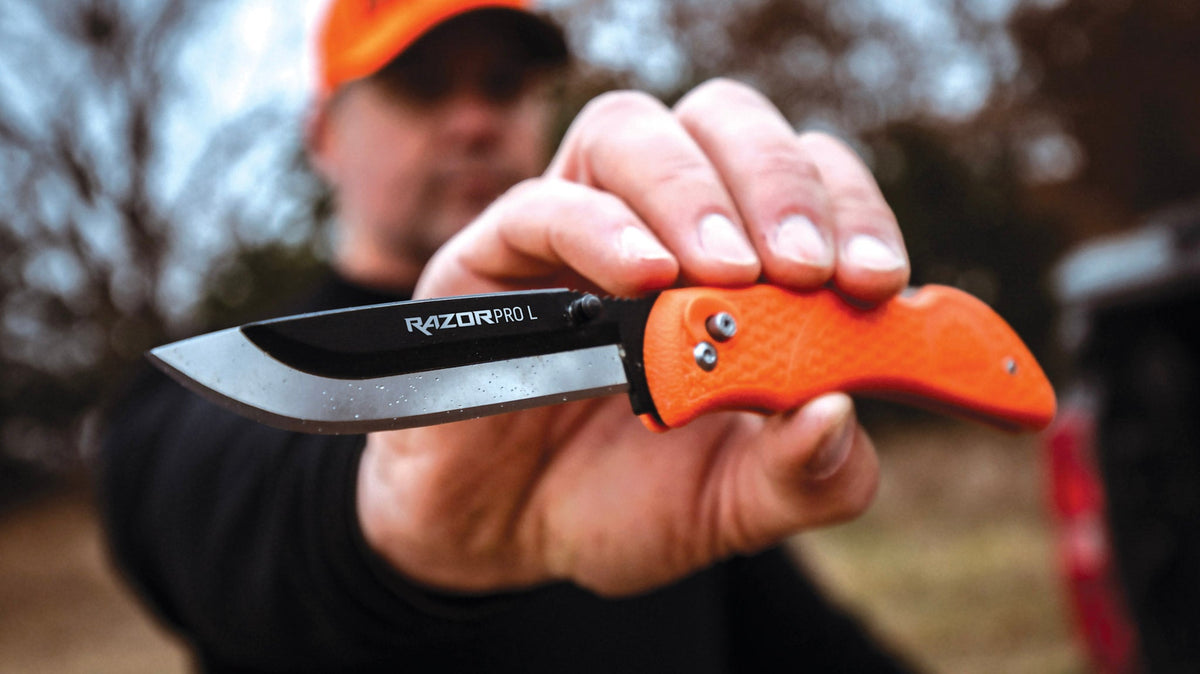
The RazorBlaze and the Origin of RazorSafe (2013 to Today)
Last updated: November 2026The RazorBlaze, launched in 2013, was Outdoor Edge's first replaceable-blade hunting knife and the foundation of what is now the RazorSafe System. It introduced the swap-not-sharpen idea to American hunters and, over the next decade, evolved into a full lineup of fixed-blade, folding, and modular knives that share one common blade architecture.
2013: The RazorBlaze launches
The first RazorBlaze reached retail in 2013. It was a single-knife product, a folding hunting knife with a 3.5-inch replaceable blade and a locking pin that disengaged with a slide-and-pull motion. The blade was 420J2 stainless at Rockwell C 54 hardness, ground to a drop-point profile. Replacement blade packs were sold separately.
The product launched into a category that did not yet exist in the American hunting market. Surgeons had used replaceable scalpel blades for a century. Drywallers had used replaceable utility blades for decades. No mainstream hunting brand had brought the same idea to a field knife. Outdoor Edge did.
The problem the RazorBlaze solved
Field sharpening had been the single biggest skill gap in hunting for as long as the modern fixed-blade has existed. Hunters who could sharpen well were a minority. Hunters who carried a dull knife into the field on opening day were the majority. Stones, strops, and rod sharpeners worked, but they required practice, time, and a steady environment. None of those exist at a tailgate at 4 a.m.
The RazorBlaze sidestepped the whole problem. The blade came factory-sharp. When it went dull, you swapped it. No skill required. No equipment required. The hunting market had been asking for that answer without knowing how to phrase the question.
The first decade: from one knife to a system
Between 2013 and 2026, the single-knife RazorBlaze grew into a full system. The milestones below mark the path.
- 2013: RazorBlaze launches. The first folding replaceable-blade hunting knife from Outdoor Edge. Single profile, single size, single handle option.
- 2015: RazorLite expands the folder line. A second folding model adds a thinner profile and a refined locking-pin design. The lineup is now two folders sharing the same blade swap mechanism.
- 2017: Fixed-blade options arrive. The first fixed-blade replaceable-blade knife enters the lineup, giving hunters who prefer fixed handles a way into the system. Caping profiles join the blade catalog.
- 2022: Blade family expands to 5 size codes. The 220, 250, 300/301, 350, and 500 size codes are now established. Each size fits a different family of handles. The 350 becomes the flagship hunting size.
- 2024: Razor APX brings modularity. The APX accepts both RazorSafe knife blades and SawSafe saw blades on one handle. One tool, two modes. The system now bridges knife and saw work.
- 2026: The full lineup. Nine blade profiles across five size codes. Folders, fixed-blades, EDC knives, caping knives, processing knives, and the APX. The RazorBlaze is still available alongside the broader catalog as a direct descendant of the 2013 original.
The RazorSafe name and what it standardized
By the time the lineup spanned multiple handles, profiles, and size codes, the platform needed a name. "RazorSafe" became the umbrella term for everything Outdoor Edge had built around the original RazorBlaze mechanism. The name standardized three things that matter to the user.
Today: RazorMax, RazorLite, Razor APX, and the blade family
The modern lineup gives a hunter four entry points into the platform. The RazorEDC Lite is the everyday folder, the direct descendant of the original RazorBlaze. The RazorMax is the flagship fixed-blade. The Razor APX is the modular handle for hunters who need both knife and saw on the same tool. And a range of EDC, caping, and processing handles fill out the smaller niches.
All four entry points run blades from the same nine-profile, five-size-code catalog. You buy the handle that fits your hunt. You buy the blades that fit your work. The system has not fundamentally changed since 2013. It has expanded.
Who actually invented replaceable-blade hunting knives?
The replaceable-blade concept is older than any modern hunting brand. Surgical scalpels with snap-in blades date to the early 1900s. Industrial utility knives with retractable replaceable blades have been standard issue in trades since at least the 1950s. The Havalon brand brought the surgical-scalpel concept to hunters in the early 2000s using small, fragile scalpel-style blades on a slim handle. That product opened the door.
What Outdoor Edge contributed in 2013 with the RazorBlaze was a purpose-built hunting blade and handle. Bigger blade than a scalpel. Beefier handle than a scalpel. Locking pin instead of a clip-on. Drop-point profile instead of a surgical curve. A consumer hunting tool from a hunting-first company. The RazorBlaze did not invent the category. It built the version of the category that scaled.
Where to go next
If you want to know how the swap system compares to a traditional sharpened blade, read replaceable vs traditional hunting knives. For the strength question, see are replaceable blade knives strong enough. To buy the descendant of the original RazorBlaze, the modern RazorLite is the direct successor. The original RazorBlaze remains in the catalog for hunters who want the foundational model.
Frequently asked questions
When was the RazorBlaze released?
2013. The RazorBlaze was the first Outdoor Edge folding replaceable-blade hunting knife and the foundation of what became the RazorSafe System. It launched with a single drop-point blade profile in a folding handle and established the locking-pin swap mechanism still used today.
Who invented the replaceable-blade hunting knife?
The concept of a replaceable blade predates modern hunting brands. Surgical scalpels and industrial utility knives used replaceable blades for decades. Havalon brought a surgical-scalpel style replaceable blade to hunters in the early 2000s. Outdoor Edge contributed a purpose-built hunting design with the 2013 RazorBlaze: bigger blade, locking pin, hunting profiles, and a handle engineered for field work.
Is the RazorBlaze still in production?
Yes. The RazorBlaze remains available alongside the broader RazorSafe lineup. The modern RazorEDC Lite is the most direct descendant in the folder category, with a refined locking-pin design and updated handle ergonomics. Both run the same blade architecture.
How did the RazorSafe System evolve from the RazorBlaze?
The single-knife RazorBlaze expanded into a folder lineup, then into fixed-blade hunting knives, then into a full catalog of 9 blade profiles across 5 size codes. The RazorSafe name was adopted as the umbrella term once the platform spanned multiple handles. The 2024 Razor APX added modularity by accepting both knife and saw blades on one handle.
What was the first replaceable-blade hunting knife?
Within Outdoor Edge, the 2013 RazorBlaze was the first. Across the hunting industry broadly, the early Havalon scalpel-style hunters predate it. The RazorBlaze was the first replaceable-blade design built specifically for hunting, with a hunting-scale blade, a locking pin, and a handle ergonomically designed for skinning and field dressing rather than surgery.
What replaced the RazorBlaze in the Outdoor Edge lineup?
Nothing replaced it. The lineup grew around it. The RazorLite is the most direct successor in the folder category. The RazorMax is the flagship fixed-blade. The Razor APX is the modular handle for hunters who need a knife and a saw. The original RazorBlaze is still available for hunters who want the foundational model.
Author: Outdoor Edge Pro Staff. 2026-11-03.


Leave a comment
This site is protected by hCaptcha and the hCaptcha Privacy Policy and Terms of Service apply.