

Are Replaceable-Blade Knives Strong Enough for Big Game?
Last updated: September 2026The strength question is the first one every traditional knife guy throws at the replaceable-blade platform. It is a fair question. The answer is more honest than the marketing on either side. Used the way it was designed, the RazorSafe blade is plenty strong for the largest game on the continent. Used the wrong way, any knife in the world will fail.
The honest answer
A RazorSafe blade will field dress, skin, and quarter the biggest deer, elk, moose, or bear in North America without breaking. We have customers running these blades on bull elk in Wyoming, bull moose in Alaska, and 300-pound feral hogs in Texas, and the failure rate on those animals is statistically zero when the knife is used as a knife.
The strength question almost never comes from people who have actually used one. It comes from the idea that a thin replaceable blade must be weaker than a thicker fixed-blade knife. On paper that sounds reasonable. In the field it misses the geometry of how the RazorSafe handle holds the blade.
The blade does not float on a pin. The blade locks into a channel that runs the full length of the handle. When you push the edge, the force does not go into the blade alone. It goes into the channel and the handle as one piece. That is the part traditional-knife instinct gets wrong.
How the RazorSafe blade holder transfers force
This is the engineering detail most reviewers skip. A traditional fixed-blade knife is one solid piece of steel from edge to butt cap. A folding knife pivots around a pin and lock. The RazorSafe handle does something different from both.
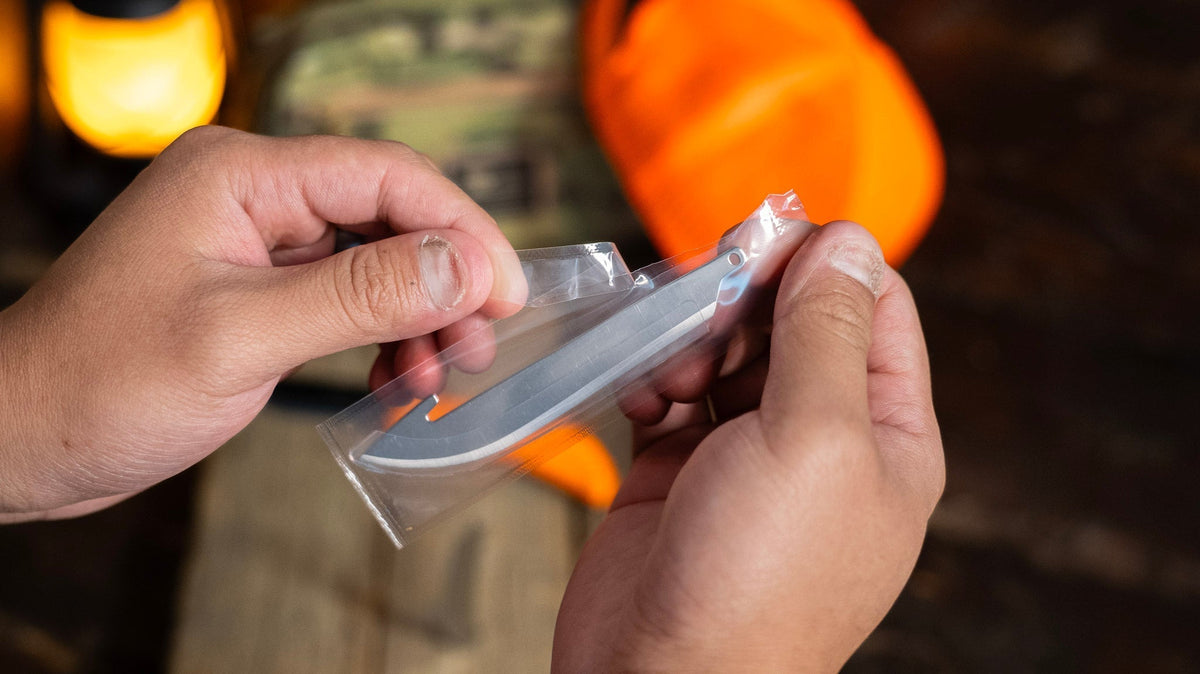
The blade slides into a channel inside the blade holder. When the lock engages, the blade is clamped against three contact points: the spine rides flat against the top of the channel, the hook at the end engages the blade holder, and the hole in the blade on the back locks inside the mechanism. That three-point clamp is what people mean when they say the blade "behaves like a full tang."
Force on the edge gets distributed across the whole channel. The blade pin is along for the ride. It is not load-bearing the way a folder pivot is load-bearing. That is why you can put a RazorSafe blade through a deer hindquarter, hit bone, and feel no flex in the handle.
For a full breakdown of the steel itself, see 420J2 stainless steel explained. The short version: 420J2 at RC 54 is a stainless that holds an edge well, resists chipping under bone contact, and tolerates the kind of micro-impacts that happen during real-world quartering.
What replaceable-blade knives can absolutely handle
Here is the work the RazorSafe platform was built to do, and does every day in the field.
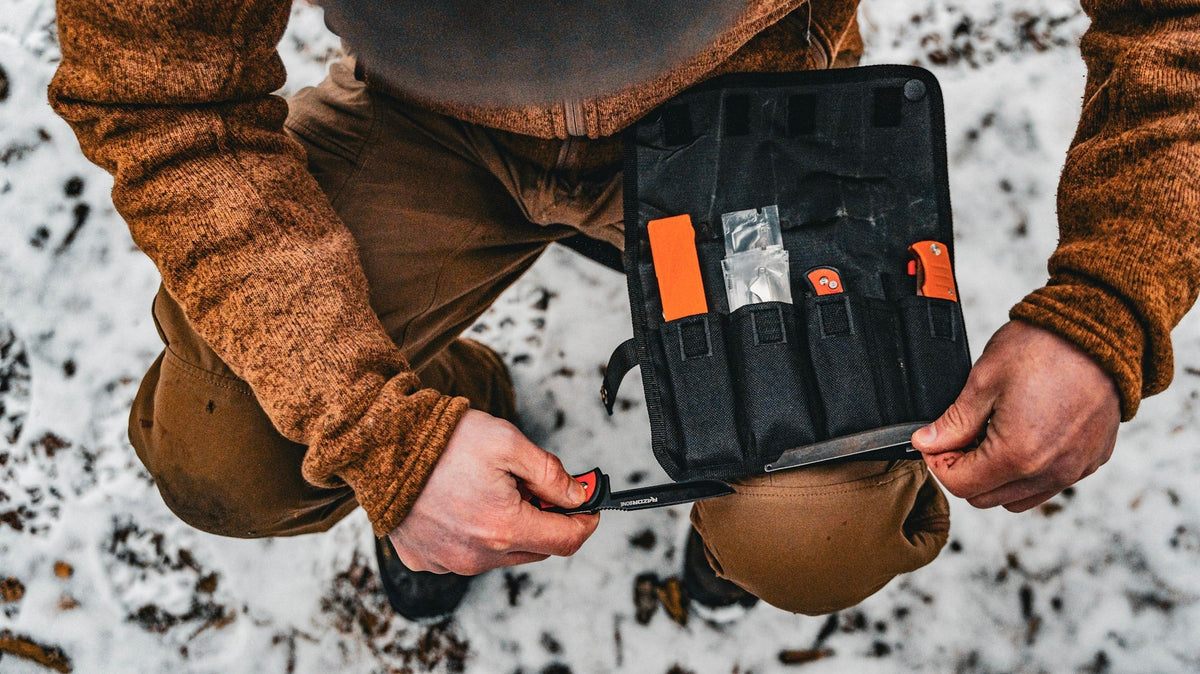
- Skinning hide off hung deer, hogs, elk, and bear. The thin blade rides the hide line better than a thicker fixed blade. Less drag, fewer nicks in the meat, cleaner cape.
- Quartering a hindquarter, including disjointing at the ball joint. The edge is sharp enough to cut tendon and ligament. The handle is stout enough to hold the blade square against the joint.
- Boning out at home. Following bone with a sharp edge is exactly what the platform does best.
- Caping for a shoulder mount. The 300 caping profile is small enough for the eyes and ears, and rigid enough not to flex into the cape.
- Fillet work on fish. The 500 profile flexes by design. Same blade family, same handle.
- Camp work and general utility. Cutting cord, opening packaging, light food prep. Nothing about the platform is fragile for everyday cuts.
What they can't and shouldn't be asked to do
Here is the other side of the same conversation. These are the failure modes, and they apply to every replaceable-blade knife on the market.
- Batoning. Driving the blade through wood with a baton against the spine. Do not. This is a fixed-knife task. A replaceable blade is not designed for repeated lateral hammer impacts.
- Prying. Twisting the edge sideways to pop a joint or open a frozen seam. Do not. The blade is thin on purpose. Side load is what breaks any knife edge, not just replaceable ones.
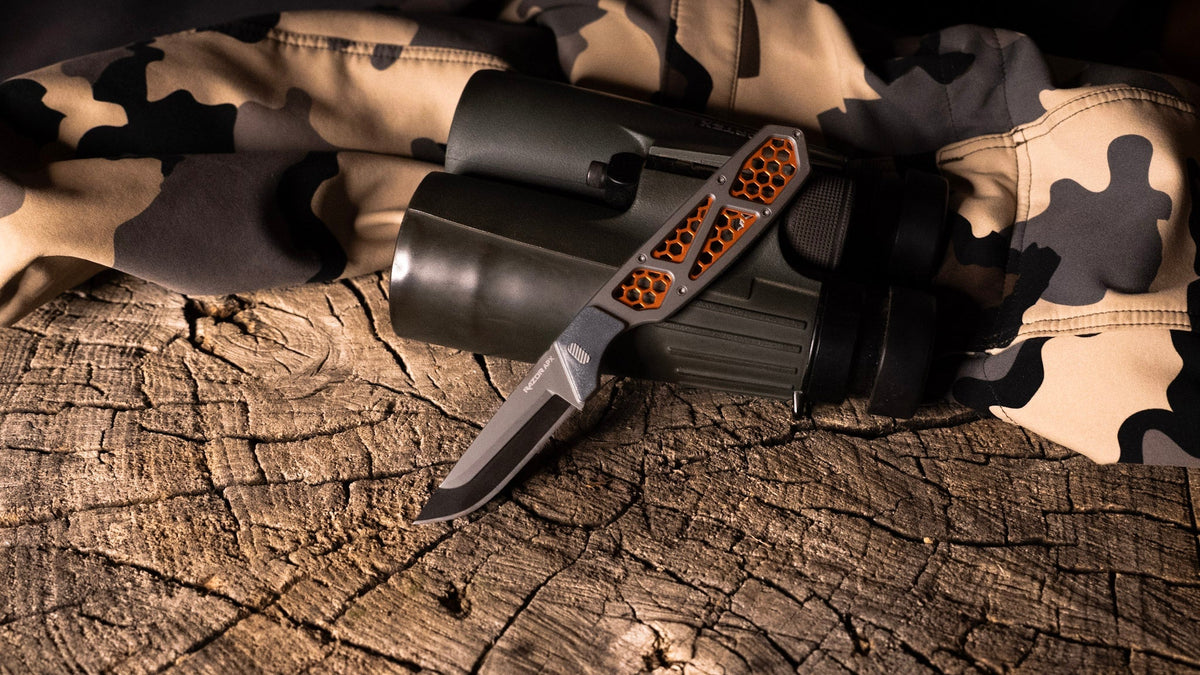
- Substituting for a bone saw on a heavy pelvis. A knife is a cutting tool. A pelvis split is a bone-saw task. If you do not have a saw, the Razor APX exists for this reason: same handle, swap to a SawSafe bone-saw blade.
- Chopping. Hatchet work belongs to a hatchet. A knife of any kind is the wrong tool.
- Hammering with the butt. The handle is rubberized polymer over a polymer core. It is not a hammer.
Real-world stress points: bone contact, joints, hide
The places people worry the blade will fail are not the places it actually gets stressed in the field.
| Task | Safe for RazorSafe? | What's really happening |
|---|---|---|
| Skinning a deer or elk | Yes | Edge work only. Almost no lateral load. Blade is in its design envelope. |
| Quartering and disjointing | Yes | Bone contact is real but controlled. The edge cuts tendon, not bone. Use joint geometry, not force. |
| Batoning firewood | No | Repeated lateral hammer load. Wrong tool. Use a hatchet or fixed-blade survival knife. |
| Prying open a frozen joint | No | Side load on a thin edge. Any knife edge can chip here. Warm the joint or use leverage from another tool. |
| Splitting a pelvis | No (use SawSafe) | Bone-saw task, not a knife task. The Razor APX runs SawSafe blades on the same handle. |
If you have not seen the side-by-side comparison with traditional knives, the full breakdown lives in replaceable vs traditional hunting knife. And if you are deciding between the two flagship platform knives, RazorMax vs RazorLite covers the choice.
The bottom line on strength
The strength conversation only ends one way once you watch someone actually run a RazorSafe through a season. The blades do the work they were designed to do. They do not do the work they were never designed to do. That is true of every knife ever made, including the most expensive fixed-blade in your safe.
If you want one tool that does both jobs, the platform answer is the Razor APX with the SawSafe option. If you want a pure cutter and you keep a bone saw in your pack, the RazorMax or RazorLite is the right answer. Browse the lineup on the RazorSafe platform page or jump straight to the Razor Hunt collection.
Frequently asked questions
Are replaceable-blade knives strong enough for elk?
Yes. The RazorSafe platform has field-dressed and quartered thousands of bull elk in Wyoming, Colorado, Montana, and Idaho without structural failures of the blade or handle. Use a knife for cutting and a saw for the pelvis, and the platform does the job the same way a fixed-blade does, just with a sharper edge every time you swap.
Can you break a RazorSafe blade?
Yes, if you misuse it. Prying, batoning, hammering, or chopping will damage any knife edge, replaceable or fixed. Used for cutting, slicing, and skinning, the blade does its job without breaking. The blade is designed to be replaced when dull, not bent or pried into failure.
Are RazorSafe blades full-tang?
Not technically. The blade itself is not one continuous piece of steel running through the handle. The blade slides into a full-length channel that clamps the spine and the tang against the handle at three points. The result behaves like a full-tang for force transfer, which is why the blade does not flex or rock under load.
Can you split a pelvis with a RazorSafe knife?
No. A pelvis is a bone-saw job. Forcing a knife edge through bone is how knife edges chip. The Razor APX exists for this exact reason: it accepts SawSafe bone-saw blades in the same handle that runs the RazorSafe knife blades. Swap the blade, not the tool.
What's the worst thing you can do to a replaceable-blade knife?
Pry with it. Side load on a thin edge is the fastest way to chip or roll any blade in the world, replaceable or not. Second worst is batoning firewood, which puts repeated lateral hammer impact on a tool that was built for cutting.
Has Outdoor Edge stress-tested these blades?
Yes. The 420J2 steel at RC 54 hardness is selected specifically to balance edge retention against chip resistance under bone contact. The blade and handle assembly is tested for cutting load, joint pressure, and lateral flex. Field testing happens every season with Pro Staff on elk, moose, bear, hog, and deer.
Razor Hunt collection · Replaceable vs traditional · the RazorSafe platform
Author: Outdoor Edge Pro Staff. 2026-09-08.

Leave a comment
This site is protected by hCaptcha and the hCaptcha Privacy Policy and Terms of Service apply.