

Replaceable-Blade vs. Traditional Hunting Knife: An Honest Comparison
Last updated: May 2026There is a real argument here, and most articles online get it wrong by picking a side. The honest answer is that replaceable-blade knives win some categories outright, traditionals win others, and the right knife for you depends on how you actually hunt. This is the version with the tradeoffs included.
The short answer
What's a replaceable-blade knife (anatomy)
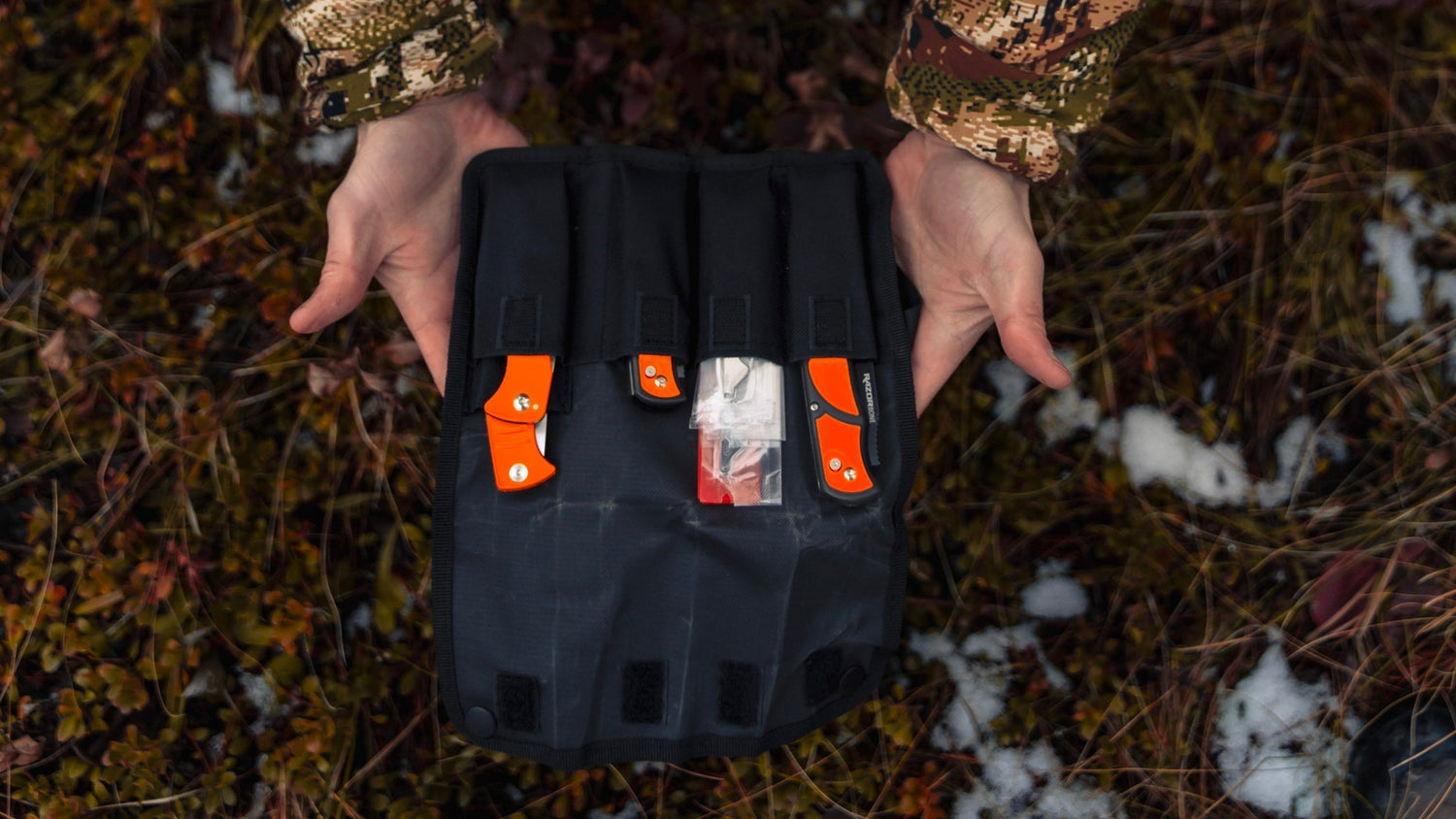
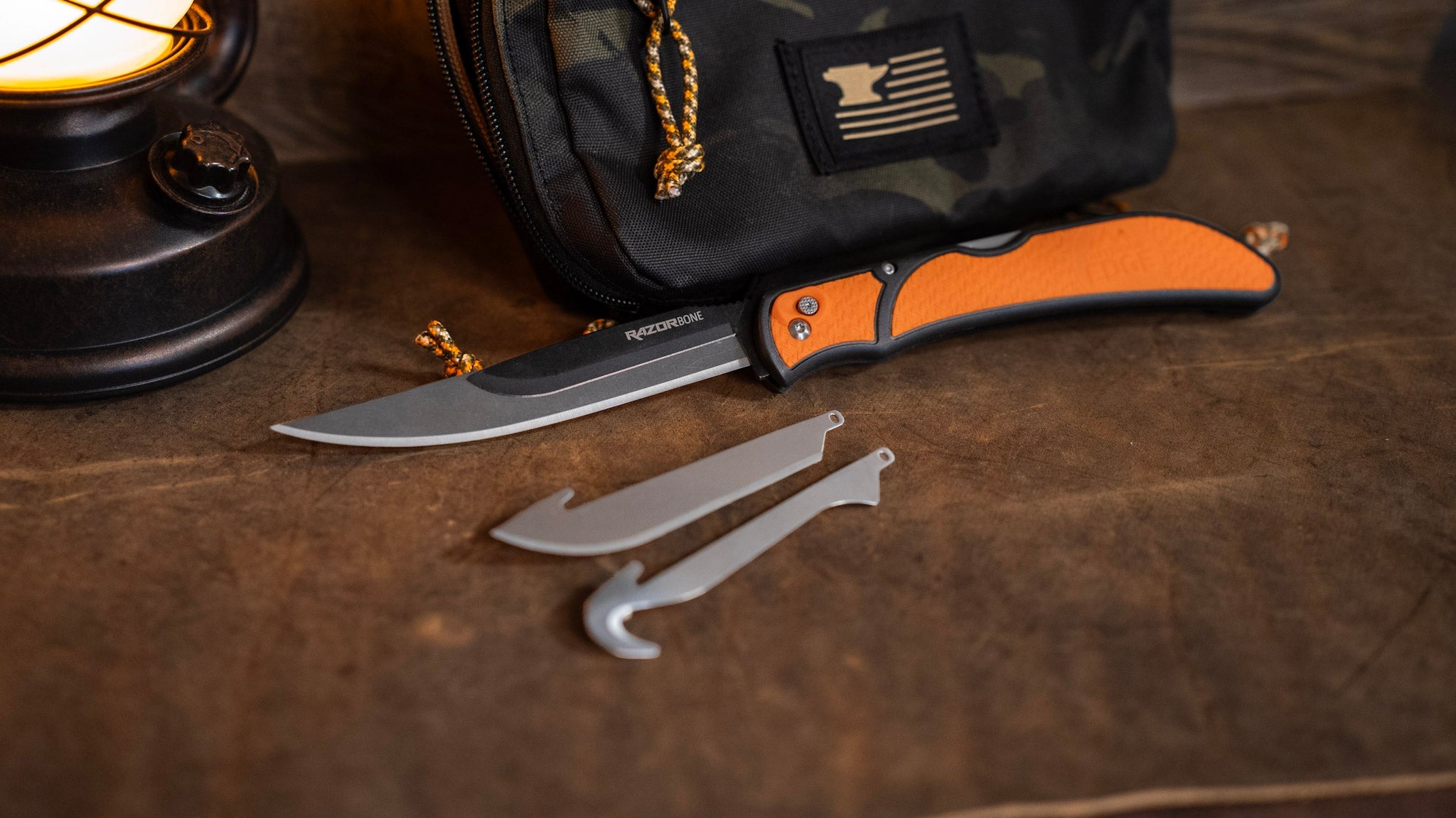
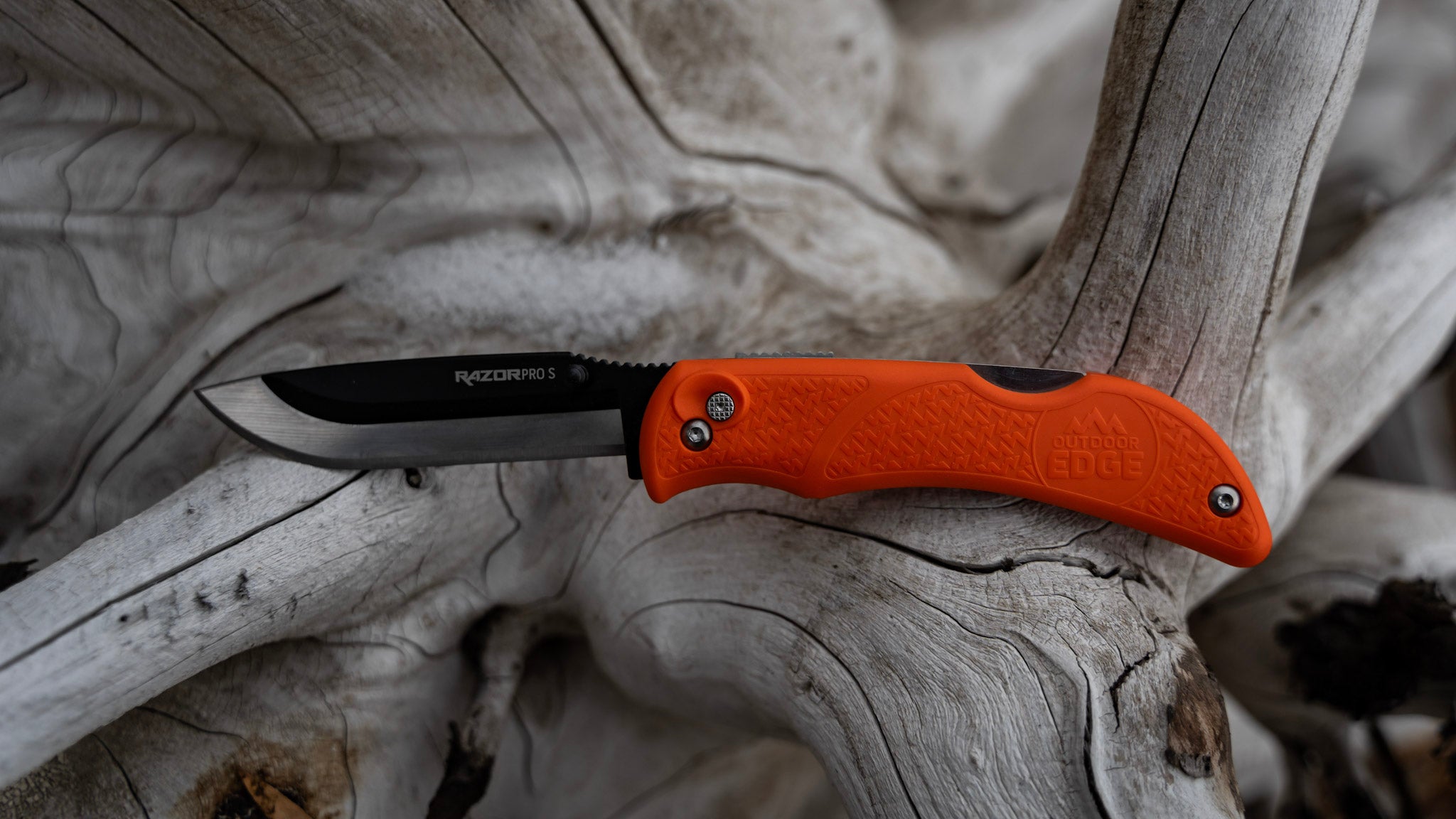
A replaceable-blade hunting knife is a handle with a locking mechanism that holds a thin, factory-sharp blade in place. When the blade dulls, you release the lock, slide the blade out, and slide a fresh one in. The handle is the permanent part. The blade is the consumable. Outdoor Edge calls this platform RazorSafe, and the blades come in 9 profiles across 5 size codes. The steel is 420J2 stainless, heat-treated to RC 57. Out-of-package sharpness is consistent and high, because every blade is ground and finished by the same factory process, not freehanded by a hunter at a kitchen table.
What's a traditional fixed-blade hunting knife (anatomy)
A traditional fixed-blade hunting knife is a one-piece blade and tang, riveted or epoxied into a handle. Steel varies wildly: 1095 carbon, S30V, S35VN, M390, A2, CPM-3V, and so on. The blade is sharpened with a stone, a strop, or a guided system, and the sharpening skill is part of the user. A good traditional fixed blade lasts a generation if it is maintained. A bad one, or a well-made one that the user cannot sharpen, becomes a dull liability halfway through a deer.
Head-to-head: 8 dimensions
The places where each knife actually wins or loses, with the honest read on each.
| Dimension | Replaceable-blade | Traditional fixed-blade |
|---|---|---|
| Edge consistency mid-process | Always factory-sharp. Swap when it dulls. | Drops off across the animal. Field-sharpening is rare. |
| Time to sharp in the field | 5 seconds to a new blade. | 15 to 30 minutes if you brought a stone. |
| Heavy-task strength like batoning | Not built for it. Will snap. | Strong. A 1/8 inch full-tang traditional eats batoning. |
| Weight | 2.6 to 5.6 oz | 5 to 10 oz |
| Cost over 10 years | $60 knife plus ~$45 in blades. Around $105. | $150 to $400 knife, $0 to $200 in stones and strops. |
| Learning curve | None. Open box, hunt. | Real. Sharpening is a skill that takes years to master. |
| Heirloom value | Low. It's a tool, not a keepsake. | High. A good custom knife is a family piece. |
| Disposal and safety | Used blades need a sharps container. | No disposal. Sharpened indefinitely. |
Where replaceable wins
Three places, all of them practical, none of them about feelings.
Edge consistency from start to finish. The biggest practical advantage of a replaceable-blade knife is that you never run a dull edge through an animal. Traditional users swear they sharpen often enough to avoid this. They are usually wrong. By the time you have skinned a hindquarter, your traditional knife has dropped 30 percent of its edge. You finish the job leaning harder, working slower, and putting more pressure on the cut. A replaceable knife stays at 100 percent because you swap the moment you feel the drag.
Time and skill barrier. Most hunters cannot sharpen well. That is a hard fact. A factory edge from a quality replaceable blade is sharper than what 90 percent of hunters produce on a stone. The hunter who pulls a fresh blade out of a pack at 8 AM has a sharper knife than the hunter who spent 20 minutes at the kitchen table the night before. The strength question is a real one, but the sharpness question is settled.
Field practicality. A 5 second blade swap in the cold, with bloody hands, after a 600 yard pack-in is a different experience than trying to find your stone in your pack, unfolding it, setting up a flat surface, and freehanding a 20 degree bevel while your buddy waits with the hindquarter halfway off. Replaceable wins this every time. It is the reason commercial processors moved to replaceable systems decades ago.
Where traditional still wins
Replaceable is not the answer for every job. Be honest about the use cases where a traditional is still the better tool.
Heavy tasks. Batoning firewood. Splitting kindling for a wet camp. Prying a stuck pelvis joint apart with the spine of the knife. These are jobs for a thick, full-tang traditional blade. A replaceable blade is too thin for any of them and will snap at the tang slot. If you bushcraft, keep a traditional in the kit.
Heirloom value. A custom fixed-blade from a quality maker is a piece of art and a piece of family history. It carries weight that no factory replaceable system can. If you want a knife your grandson will use, buy a traditional. We are not going to argue with that, because it is correct.
Backcountry self-reliance. If you are 10 days into a remote hunt with no resupply, the failure mode of a replaceable knife is running out of blades. The failure mode of a traditional is needing a sharpening. The traditional wins if you trust your sharpening more than you trust your inventory management.
Total cost of ownership over 10 years
The honest math, run over a realistic decade.
Traditional (mid-range $200 knife): $200 knife + $80 in stones, strops, and oils + 1 professional re-grind around year 5 ($40) = around $320. Assumes you do not lose, break, or replace it.
Traditional is cheaper on paper. Replaceable is cheaper if you value your time at $20 per hour and you would spend 4 hours per season sharpening. The two methods come out close enough that cost should not be the deciding factor. Full cost-over-time breakdown is in a dedicated piece.
What hunters actually say
From years of customer feedback, three patterns show up consistently.
Converts are vocal. Hunters who switch from traditional to replaceable almost never go back. The reason is always edge consistency through the job, not cost or convenience.
Holdouts have one specific reason. Hunters who refuse to switch are usually skilled sharpeners with a knife they care about. They are correct, for them. They are not wrong because their use case does not match.
The middle group runs both. The most common setup we see in 2026 is a replaceable-blade working knife (often the RazorMax or RazorLite) on the belt or in the pack, and a traditional fixed-blade in the camp box or the truck for heavy work and as a backup. This is the right answer for most serious hunters.
Where to go next
If you are leaning replaceable, the Razor Hunt collection is the lineup. If you want to dig into the strength argument that holds most hunters back, read are replaceable-blade knives strong enough. If you want the long-term cost picture run out further, the cost-over-time breakdown goes deeper.
Frequently asked questions
Are replaceable-blade hunting knives as strong as traditional knives?
For the cutting tasks they are designed for (skinning, gutting, quartering, boning), yes. The 420J2 stainless blades run at RC 57 and are factory-ground to a sharper edge than most traditional knives in the field. For heavy tasks like batoning firewood or prying joints with the spine, no. A thin replaceable blade will snap. Use the right tool for the task.
Which is cheaper over 10 years?
A mid-range traditional knife is slightly cheaper on paper, around $320 vs $510 for a replaceable system processing 3 to 5 deer-sized animals a year. Once you factor in time spent sharpening, the gap narrows. Cost should not be the deciding factor between the two systems.
Can you sharpen a RazorSafe blade?
You can, but the math does not favor it. A new 4 to 6 blade pack starts at $14.99. A used blade is worth less than a dollar. Most hunters retire the blade and load a fresh one. The blade is the consumable, not the handle.
Do replaceable-blade knives feel like real knives?
Yes. The handle ergonomics on a RazorMax or RazorLite are equal to or better than most production traditional knives in the same price range. The locking mechanism is solid. The blade does not flex unless you lean on it sideways. Once you have used one for a season, the question stops coming up.
Why would anyone still use a traditional fixed-blade?
Three reasons. First, heavy bushcraft tasks like batoning or prying. Second, heirloom value. A good custom knife is a family piece. Third, deep backcountry self-reliance where running out of blades is a worse failure than needing to sharpen. All three are legitimate use cases.
Is a replaceable-blade knife good for someone new to hunting?
It is the best choice for a new hunter. The factory edge eliminates the sharpening skill barrier. The blade swap is intuitive. The risk of working with a dull knife (the most common cause of hunting knife injuries) is dramatically lower. New hunters should start with a replaceable system and add a traditional later when they know what they actually want.
Author: Outdoor Edge Pro Staff. 2026-06-17.

Leave a comment
This site is protected by hCaptcha and the hCaptcha Privacy Policy and Terms of Service apply.