
Why Outdoor Edge Uses 420J2 Stainless Steel for RazorSafe Blades
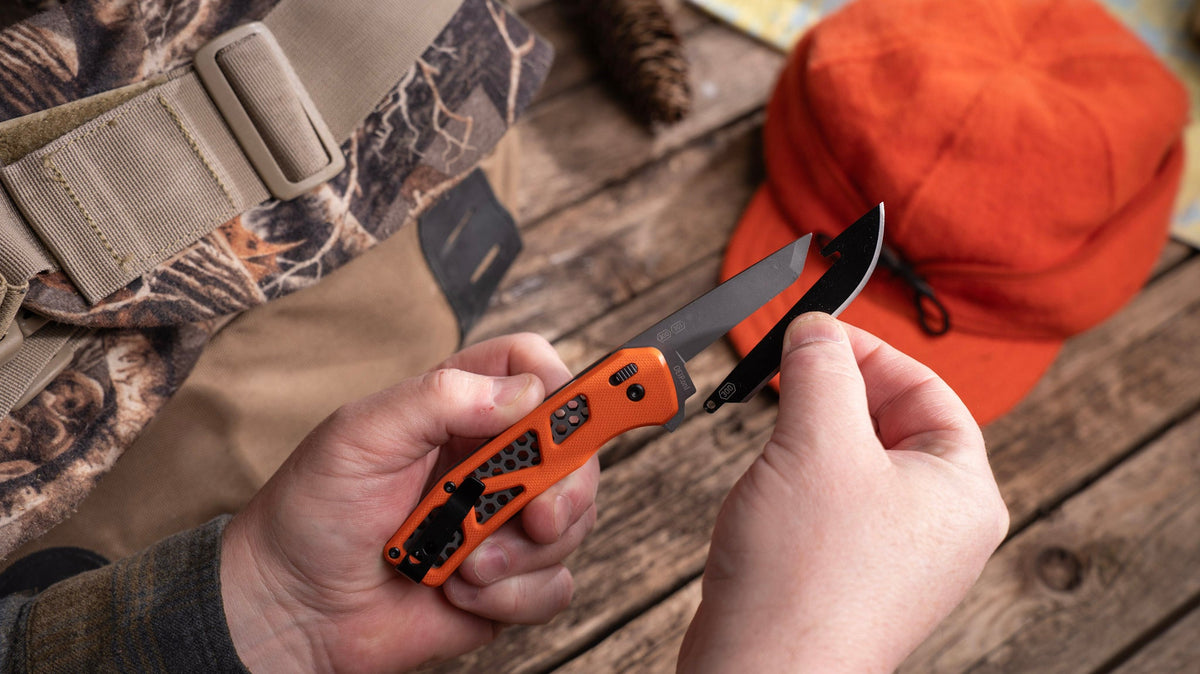
Last updated: Oct 2026420J2 is a high-chromium Japanese stainless steel chosen for RazorSafe blades because it balances corrosion resistance, ease of mass production, and acceptable edge retention at the right cost. Heat-treated to Rockwell C 54, a 420J2 blade holds a factory edge through one to three deer-sized animals before swap-out.
What 420J2 is
420J2 sits in the 420 family of martensitic stainless steels, which are the workhorses of the kitchen, medical, and field-knife industries. Within the family, 420J2 is the higher-carbon, higher-hardness cousin of 420J1. Carbon around 0.30 percent. Chromium around 13 percent. Trace molybdenum, silicon, and manganese. The Japanese mills that produce it have decades of refinement on the heat-treat process, which is why most production hunting blades made overseas trace back to the same alloy family.
It is not exotic. It is not boutique. It is the same broad family that supplies replaceable scalpel blades in medicine and replaceable utility blades in industry. The metallurgy is well understood, the quality control is mature, and the supply chain is reliable.
Why hardness matters: the RC 54 choice
Rockwell C is the hardness scale used for knife steels. The higher the number, the harder the steel. Harder steels hold an edge longer but chip more easily and resist resharpening. Softer steels roll the edge instead of chipping but go dull faster. The choice is a tradeoff, and the right answer depends on the job.
RazorSafe blades are heat-treated to Rockwell C 54. That puts them in the same hardness range as most quality production hunting knives. Hard enough to slice cleanly through hide, hair, and fat for one to three deer-sized animals. Soft enough to bend instead of chip if the edge contacts an unexpected bone or buckshot. Soft enough to grind economically on a production line, which keeps blade cost low.
Higher hardness is not always better. A blade at RC 62 holds its edge longer but is more likely to fracture under lateral load. For a consumable that you swap when the edge dulls, the edge-retention upside of harder steel is wasted. You bought the right to swap. You did not buy the right to fracture the blade at the wrong moment.
Corrosion resistance in the field
420J2 contains roughly 13 percent chromium. That is above the 10.5 percent threshold conventionally used to define stainless steel. In practice, this means a 420J2 blade survives normal exposure to blood, fat, snow, and rain without corroding during a hunt. Salt water and prolonged immersion still cause issues if you skip basic care, but a wipe-down at the end of the day is enough for most conditions.
By comparison, carbon steels like 1095 carry less than 1 percent chromium. They take a screaming edge but will surface-rust within hours of exposure to wet hide or blood. They are not the wrong steel for every use case. They are the wrong steel for a blade that lives in a knife bag for a six-month off-season.
420J2 vs. S30V vs. 1095 (the honest comparison)
Three steels, three different design philosophies. Each is the right answer for a specific knife. None is the universal best.
| Steel | Hardness | Corrosion resistance | Edge retention | Ease of resharpen | Cost per blade |
|---|---|---|---|---|---|
| 420J2 | RC 54 | Very good | Acceptable for 1 to 3 animals | Easy (but irrelevant in a swap system) | Around $1.50 to $3.50 |
| S30V | RC 59 to 61 | Excellent | Long, premium tier | Difficult, needs diamond stones | Around $80 to $250 finished knife |
| 1095 | RC 56 to 58 | Poor without oil | Good, but degrades fast in wet conditions | Easy with a stone | Around $40 to $120 finished knife |
The takeaway is not that 420J2 is the best of the three. It is that 420J2 is the right steel when the blade is consumable. S30V is the right steel when the blade is the knife. 1095 is the right steel when the user is committed to oiling and stripping a carbon-steel edge.
Why higher-end steel is the wrong answer for replaceable blades
Hunters new to the replaceable-blade category sometimes ask why Outdoor Edge does not use S30V, M390, or some other premium alloy in the blades. The reasons are concrete, not marketing.
First, premium steels cost three to ten times more per pound. A blade pack of six S30V blades would price out at $40 to $60. The economics of a swap-on-dull system require that the consumable cost stays in the sub $3 per blade range. Higher-cost steel breaks the model.
Second, premium steels are harder to grind. The factory edge on a premium-steel replaceable blade would either cost more to produce or come off the line less consistent. Mass-produced consistency is a feature of 420J2.
Third, the user benefit of premium steel is longer edge retention. You bought the right to swap, which makes longer retention irrelevant. The system is faster than sharpening. You do not need a steel that holds an edge for ten animals when you are designed to swap at one to three.
The cost-per-cut math
Replaceable blades change the unit of cost. The right question is not what the blade costs. It is what the cut costs. Most blade packs run $13.99 to $14.99 for 4 to 6 blades, and bulk 24-packs run $34.99. That puts each blade between roughly $1.50 and $3.50, or about $2.33 in a standard 6-pack. Each blade does the work of skinning, gutting, and quartering for one to three deer-sized animals before swap.
Run the numbers honestly. A traditional fixed-blade hunting knife in S30V at $200 amortizes over decades but requires a $40 to $200 sharpening kit, the time to use it, and the skill to maintain a consistent angle. A RazorSafe handle plus two seasons of blade packs runs you under $100 total and removes the sharpening curve. For most hunters, the cost-per-cut math favors the RazorSafe system.
Where to go next
If you want the strength side of the conversation, the strength question covers what 420J2 at RC 54 can and cannot do under lateral load. For the profile side, walk through the 9 blade profiles guide. To buy the blades themselves, the RazorSafe replacement blades collection is here.
Frequently asked questions
What is 420J2 stainless steel?
420J2 is a low-carbon, high-chromium martensitic stainless steel originating in Japan. Carbon around 0.30 percent, chromium around 13 percent. The high chromium delivers strong corrosion resistance. The moderate carbon makes it easy to grind, heat-treat, and mass produce. It is widely used in production hunting knives, kitchen knives, and replaceable industrial blades.
Is 420J2 a good knife steel?
For a consumable, replaceable blade, yes. It holds a factory edge through one to three deer-sized animals, resists corrosion in normal field conditions, and prices low enough to keep the swap model economic. For a fixed-blade knife that you sharpen and use for decades, premium steels like S30V and M390 hold an edge longer. Different jobs, different steels.
Why don't RazorSafe blades use S30V or M390?
Three reasons. Premium steels cost three to ten times more per pound, which would push blade-pack prices to $40 to $60 and break the swap economics. Premium steels grind harder, which would hurt factory-edge consistency. And the user benefit of premium steel is longer edge retention, which is irrelevant when the system is designed for swap, not resharpen.
How hard are RazorSafe blades (Rockwell)?
Rockwell C 54. That puts them in the same hardness band as most quality production hunting knives. Hard enough to cut cleanly through hide, fat, and connective tissue for multiple animals. Soft enough to bend instead of chip under lateral load. Soft enough to grind economically on a production line.
Does 420J2 rust?
It can, under prolonged exposure to salt water or moist storage without care. In normal field use, wiping the blade and handle dry at the end of the day prevents rust entirely. The 13 percent chromium content puts 420J2 well above the stainless threshold. Compared to carbon steels like 1095, 420J2 is dramatically more corrosion-resistant.
How does 420J2 hold an edge compared to 1095?
About the same, in normal field conditions. 1095 takes a slightly sharper factory edge if perfectly maintained, but it goes dull faster in wet conditions because it lacks corrosion resistance. 420J2 holds a stable working edge longer in the kinds of moisture, blood, and temperature swings a hunting blade actually sees. Edge retention is also less relevant in a swap system. The blade is replaced before retention is the limiting factor.
Author: Outdoor Edge Pro Staff. 2026-10-30.


Leave a comment
This site is protected by hCaptcha and the hCaptcha Privacy Policy and Terms of Service apply.