

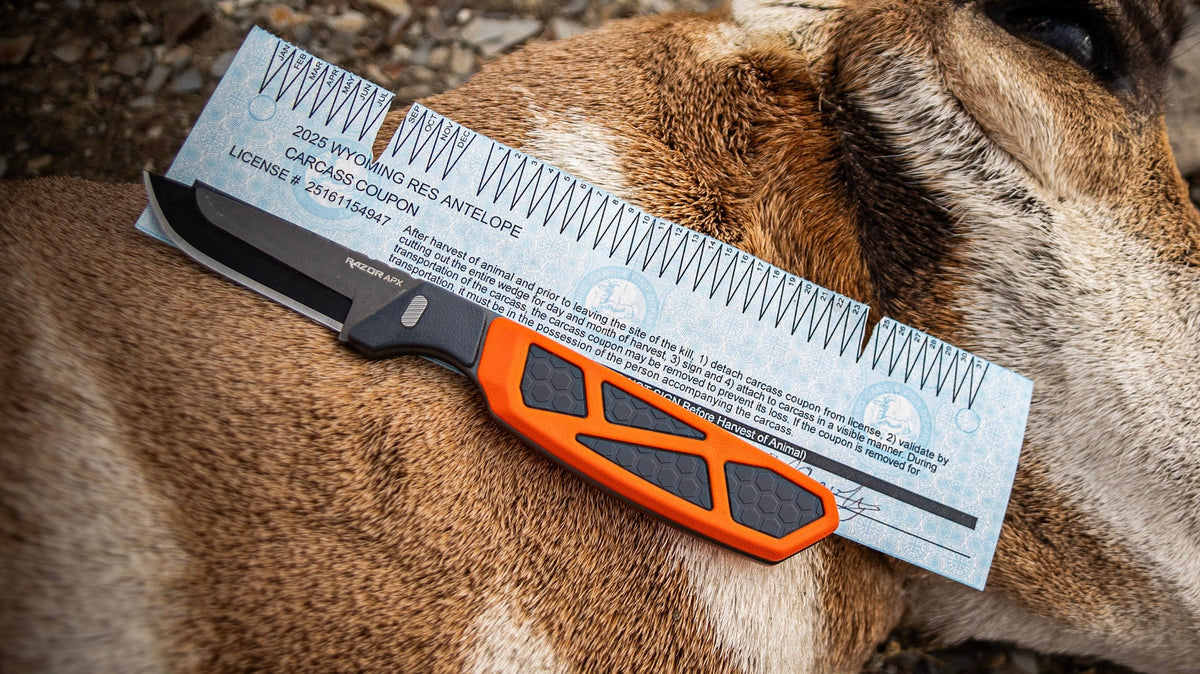
RazorSafe Cost Over Time: Replacement Blades vs. Sharpening Tools
Last updated: September 2026The cost objection is the second one we hear most often. The first is the strength question. Both have the same problem: people compare a single blade pack to a single sharpening stone instead of looking at the 10-year run rate. Here is what the actual math looks like, with every assumption on the table.
The short answer
If you take 2 to 3 deer-sized animals a year, the 10-year cost of running a RazorSafe is within $50 of running a traditional fixed-blade with a sharpening setup. The choice is not really about money. It is about whether you would rather pay up front for sharpening gear and put 20 minutes of work into every dull edge, or pay per-blade for a fresh edge in 5 seconds in the field.
Cost assumptions, laid out transparently
Most "cost over time" arguments hide their assumptions. Ours are on the table.
- Animals per year: 2 deer plus 1 hog. A reasonable run rate for a hunter who takes the platform seriously.
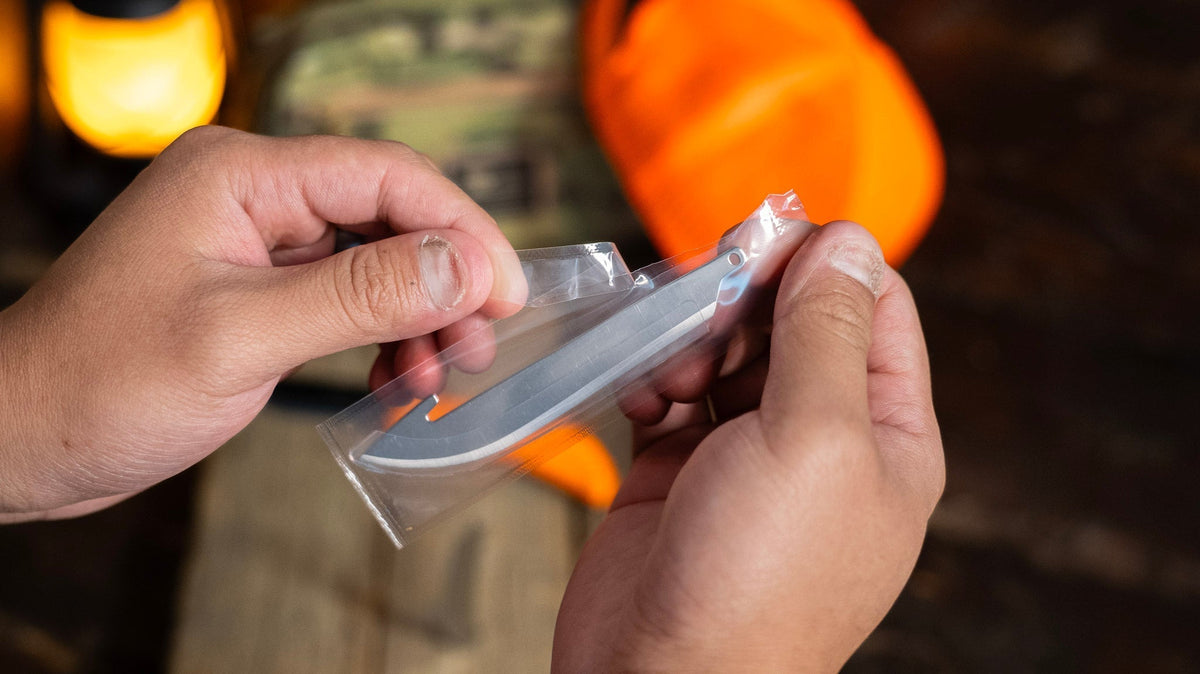
- Blades per animal: 3 RazorSafe blades for a deer-sized animal worked clean (field dress, skin, quarter). 4 for a hog.
- Blade pack price: $14.99 for a 6-pack at $2.50 per blade. We use this as the base rate. Larger packs lower the per-blade cost slightly.
- Traditional knife price: $150 for a comparable mid-tier fixed-blade. The platform competes with knives at this price, not with $40 hardware-store knives or $400 custom blades.
- Sharpening gear: $80 to $120 for a quality guided-angle sharpener or whetstone set. Replace stones once over 10 years, so call it $150 total.
- Pro sharpening: $10 to $20 per sharpen if you do not sharpen yourself. We model the DIY case and note the pro case at the end.
- Time value: We do not assign a dollar value to your time. If you do, the math shifts in favor of replaceable blades fast.
- Razor APX or RazorMax up-front cost: $59.99 to $84.99. We use $75 as the model.
10-year RazorSafe TCO
| Line item | Year 1 | Years 2-10 | 10-year total |
|---|---|---|---|
| Handle (RazorMax / APX) | $75.00 | $0.00 | $75.00 |
| Blades for 2 deer + 1 hog (10 blades/yr) | $25.00 | $250.00 | $275.00 |
| Sharpening gear | $0.00 | $0.00 | $0.00 |
| Sharpening time (DIY) | 0 hours | 0 hours | 0 hours |
| 10-year cash total | $350.00 |
10-year traditional knife TCO
| Line item | Year 1 | Years 2-10 | 10-year total |
|---|---|---|---|
| Fixed-blade knife (mid-tier) | $150.00 | $0.00 | $150.00 |
| Sharpening system (guided / stones) | $100.00 | $50.00 (replacement stones) | $150.00 |
| Strop, oil, maintenance supplies | $20.00 | $45.00 | $65.00 |
| Sharpening time (DIY, 20 min per animal) | 1 hour | 9 hours | 10 hours |
| 10-year cash total | $365.00 + 10 hours |
Pure cash, the traditional setup is roughly the same over 10 years. Add 10 hours of sharpening time, and the gap increases the moment you assign any dollar value to your time. At $10 per hour of opportunity cost, the two systems break even. At $20 per hour, RazorSafe is cheaper. At $30 per hour, RazorSafe wins.
If you do not sharpen yourself and pay a pro $15 per animal over 10 years (30 animals at $15 each), that adds $450 to the traditional column. RazorSafe wins big in that scenario.
Per-deer-processed cost breakdown
Here is the same math at the per-animal level, which is how most hunters actually think about it.
| Scenario | RazorSafe per deer | Traditional per deer |
|---|---|---|
| Cash only (DIY sharpening) | $7.50 (3 blades) | $10.50 (gear amortized) |
| Cash + 20 min time at $20/hr | $11.25 | $17.17 |
| Cash + pro sharpening at $15 | $11.25 | $25.50 |
| Cash + pro sharpening at $20 | $11.25 | $30.50 |
For DIY sharpeners who genuinely enjoy the work, the two systems are dead even on cash. For everyone else, the math tilts toward replaceable blades. For a side-by-side breakdown that goes beyond cost, see replaceable vs traditional hunting knife.
Stockpile-sizing guide for a hunting season
Cost is one thing. Running out of blades on opening day is another. Here is the math on what to buy before the season starts.
- Count your tags honestly. 1 whitetail, 2 hogs, 1 caping job. That is 4 animal events for the season. Be realistic, not optimistic.
- Multiply by per-animal blade count. 3 blades for a deer, 4 for a hog, 2 for the caping. That is 3 + 4 + 4 + 2 = 13 blades for the season.
- Round up to a full pack. Round 13 up to 16 blades. That is four 6-packs at $14.99 each, or $59.96 total.
- Add one buffer pack. One extra 6-pack at $14.99 covers a dropped blade, an extra animal, or a friend who shows up at the gambrel without his own kit. Total: $74.95.
- Buy in summer, not in October. The 350 drop-point goes on backorder every fall. The cost of running out mid-season is the rest of your hunt, not the price of the blade pack.
When RazorSafe wins on cost, when traditional wins
The honest answer depends on your habits.
RazorSafe wins on cost when:
- You do not sharpen yourself.
- You assign any dollar value to your time.
- You process the animal yourself and want a fresh edge for the loins.
- You hunt with friends or family who need to borrow a knife and never replace the edge they wore down.
Traditional wins on cost when:
- You already own a sharpening setup and enjoy using it.
- You do not value your time as a cost.
- You inherited a knife you do not want to retire.
For the durability side of this conversation, walk through the strength question. The cost answer means nothing if the tool does not do the job. The strength answer is in the system, not the marketing.
Replacement blade collection · Outdoor Edge's replaceable blade platform
Frequently asked questions
How much do RazorSafe replacement blades cost?
A 6-pack generally sells at $14.99, which works out to $2.50 per blade. Larger packs (24-count) lower the per-blade cost. Caping and utility profiles in the 300 family run the same range, with the 500 boning and fillet pack a few dollars higher per pack because the blade is larger.
Is RazorSafe cheaper than sharpening over time?
Roughly the same in pure cash, with RazorSafe pulling ahead the moment you assign any value to your time or pay a pro to sharpen. Over 10 years and 30 animals, traditional with DIY sharpening is about $95 cheaper in cash. Add 10 hours of sharpening labor at any wage, and RazorSafe wins.
How long does a RazorSafe blade last on one deer?
One blade will field dress and start the skin on a deer. Most hunters swap once during skinning and once more before quartering, for a total of 2 to 4 blades per deer worked clean. Hogs take more because the hide is tougher and dirtier.
How many blade packs should I buy per season?
Count your tags, multiply by 3 to 4 blades per animal, then round up to the next full 6-pack and add one buffer pack. For a hunter taking 2 deer and 1 hog, that is 4 packs at $59.96 plus one buffer pack at $14.99. Total: $74.95 for a full season's stockpile.
Are there cheaper aftermarket RazorSafe blades?
Aftermarket replaceable blades exist for some surgical-style platforms, but the RazorSafe blade-and-handle geometry is proprietary. Knock-off blades that fit the channel do not exist, and the ones that do exist do not match the 420J2 steel spec or the RC 54 hardness. The cost difference is small. The risk to your edge and your animal is not worth it.
What's the true cost of a sharp blade in the field?
For RazorSafe, it is $2.50 and 5 seconds. For a traditional knife, it is 20 minutes of sharpening at the truck (or a dull blade for the rest of the job). The cash difference is small. The time difference is the whole conversation.
Author: Outdoor Edge Pro Staff. 2026-09-22.

Leave a comment
This site is protected by hCaptcha and the hCaptcha Privacy Policy and Terms of Service apply.